Monday, December 17, 2012

Hyderabadi Baigan


This is a recipe that I have been making quite often (almost once a week, my husband loves it).  Hyderabadi Baigan ("Eggplant from Hyderabad, India") is an excellent side dish for any davvat and is sure to impress your Pakistani native guests.  Soft, melt-in-your-mouth eggplant in a saucy, savory mix.  It has a medium difficulty level and requires several steps to complete, however, if you are reading this blog, you will be well-equipped!  ;)  I learned this recipe while watching my mother-in-law make it and it is one of our family favorites.

I'll never forget when it was made for some family members from the Hyderabad area and they exclaimed that it tasted just like home.  This is indeed, the real deal.


To start, slice a medium onion and put it in enough vegetable/canola oil to cover the base of a large pot (about 1/2 cup).  Cook on medium/high heat until limp and slightly browned on the edges.


Using a slotted spoon, remove the cooked onions and put them in a food processor with about a three-quarter cup of water.  Puree the onions and water into a paste and leave them there for now...
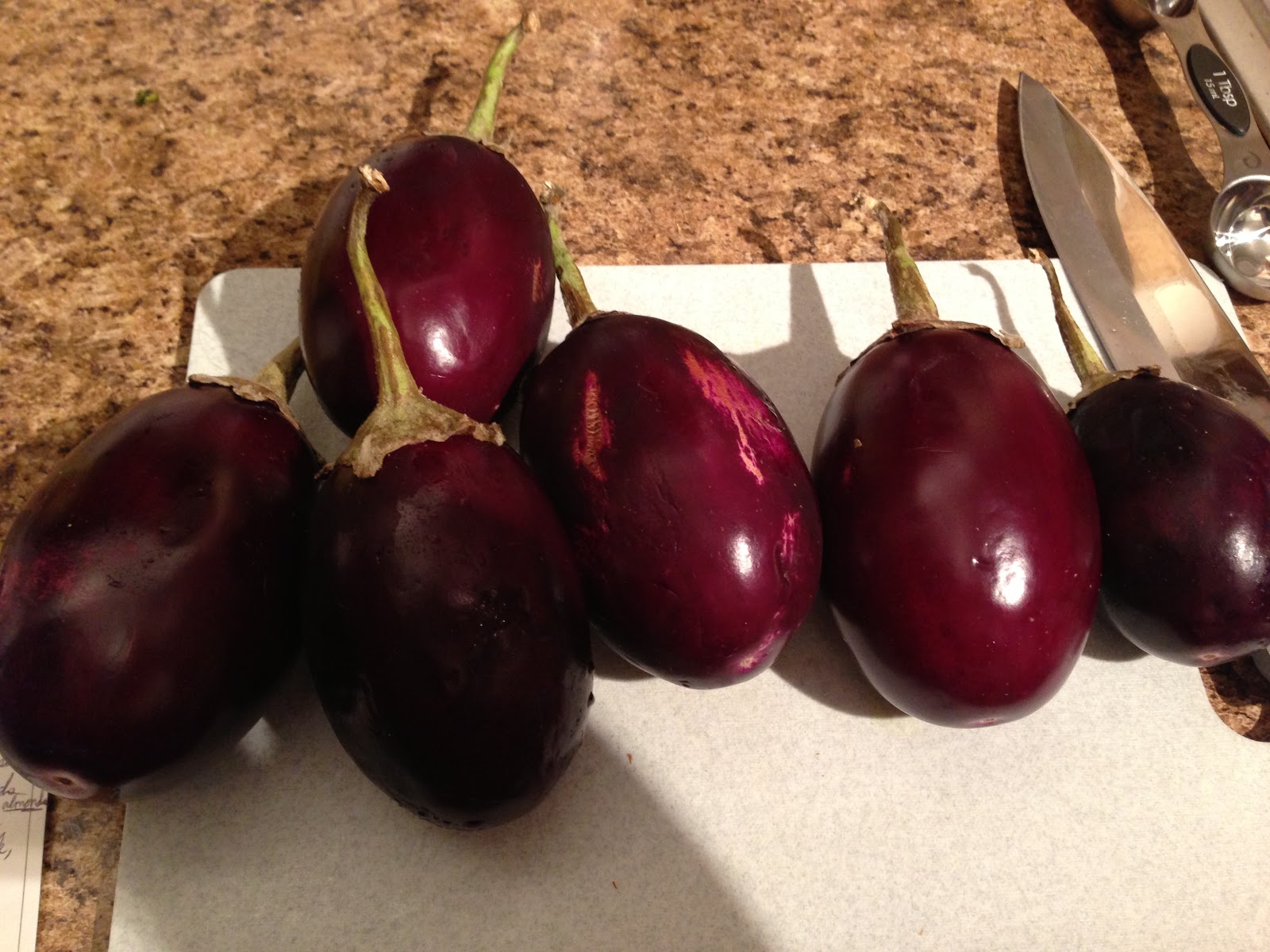

Take 6 LARGE Indian eggplants (the largest ones you can find-- size of a fist or larger!  If you can only find smaller ones, use 7 or 8) and slice a plus sign in them all the way to the stem without going through the stem.


Like this.


Then gently put the eggplants in the oil and cook on medium/high heat, rotating them on each side until they look flat/soft.  The above picture is what they look like when finished.  Remove them from the oil and set aside.


Next take a separate small pan and add 3 Tablespoons of coconut powder, 3 Tablespoons of sesame seeds, 7 fenugreek seeds, 1/2 teaspoon of mustard seeds, 1 1/2 teaspoons of cumin seeds, 8 whole peanuts, and 8 whole almonds (I didn't have peanuts, so I just used about 12 almonds instead) and roast on medium/high heat.


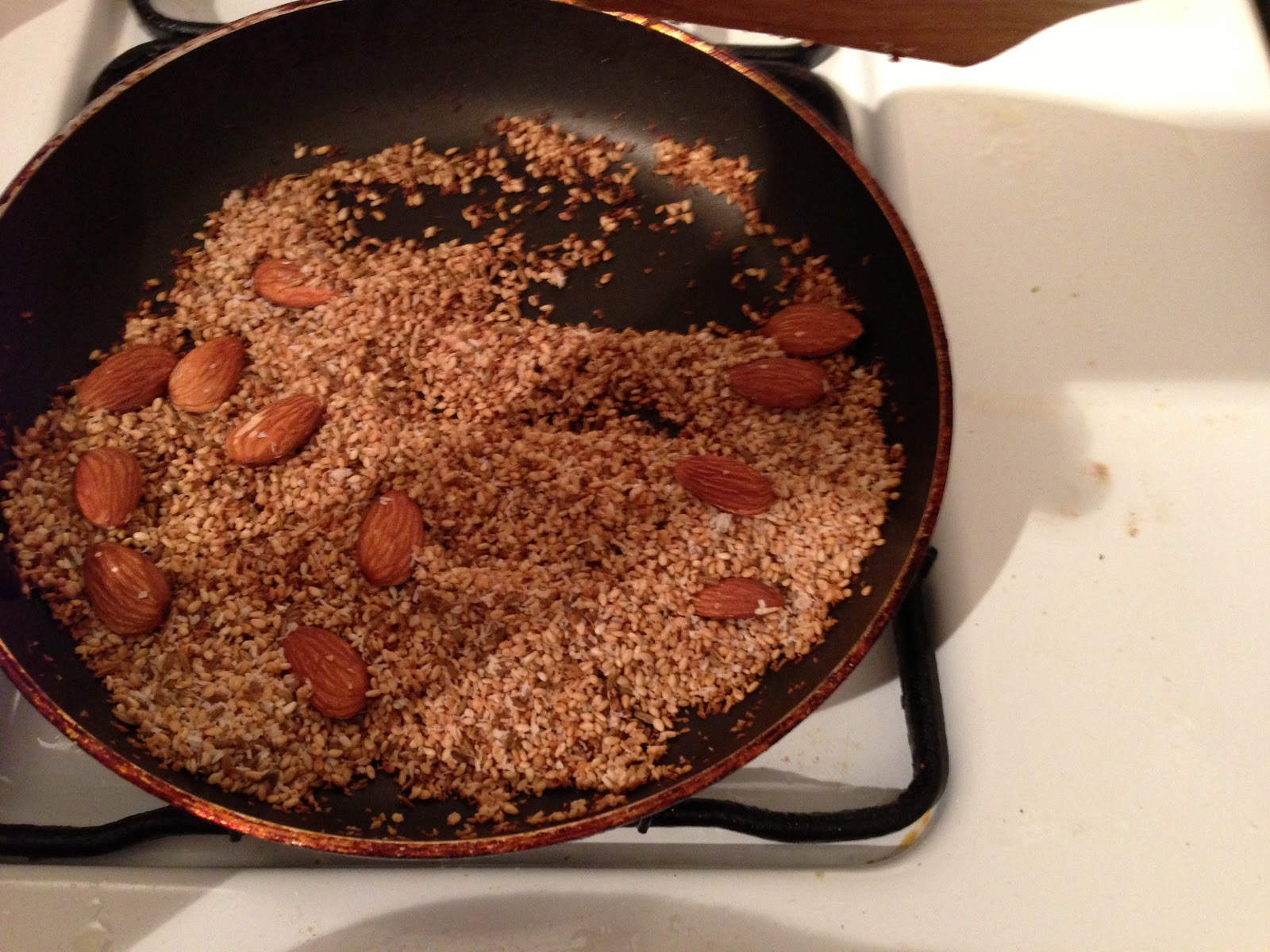
Using a spatula or wooden spatula, roast the seed mix until everything is golden brown.  It will start snapping and when it looks like the above picture, you can remove the heat.


Next, put your seed mixture into a coffee grinder and grind into a fine powder (it's okay if there are some almond or peanut chunks, but try to get it as small and fine as possible).


It will look something like the above picture.


 Add your seed mixture to the onion paste in the food processor and puree (this will also chop up the peanuts or almonds better if needed).


Pour the mixture into the large pot with the oil (that was used earlier for the onions and eggplant) and add 5 curry leaves, 1 teaspoon of ginger/garlic paste, 1 teaspoon of red chili powder, and 1/2 teaspoon of tumeric powder.


Meanwhile, in a separate pot, boil about 2 tablespoons of wet tamarind in about a cup of water.  If you are an achi bivi and can handle it, you can do this step while you're frying the onions or frying the eggplant to save time.  Once the seeds have loosened from the tamarind, you can mush them out with your hand.


Almost forgot to take a picture of all the garbage you should take out of your tamarind...  I know, it looks like guts up there, but I thought you'd want to know.  There's all kinds of weird things in tamarind that you want to get out.  My mother-in-law JUST told me, by the way, that I can use a tamarind paste that is already made...  That I didn't have to buy this thick stuff and mush out all the guts...  ...  So...  You can try that too ;).


In any case, add the good parts of your tamarind to the large pot, add about a tablespoon of salt, and cook covered for 10 minutes on medium heat.  Do a taste test at this point.  The sauce should taste spicy, salty, and like your seed mixture.  You should be able to taste all three of those things evenly.  If you can't, add a little bit of what's missing until you do.  Most of the time, with the recipe I've provided, I don't have to add anything.


 Next add your fried eggplant back into the large pot and cook covered for another 10 minutes.


Chop up some green chillis (2) and ~1/2 cup of fresh cilantro for garnish and serve with naan or paratha!


 Viola!  A lot of steps, but once you make it a regular part of your achi bivi life, it is a LOT easier.


Monday, December 10, 2012

Karhi


Up until today I have been posting mostly simple recipes (hey! it takes time to write these out!).  Karhi is not necessarily a difficult dish, but it can quickly turn from perfect to plumpy if not monitored or executed correctly.  If you aren't used to Pakistani food, you may want to delay making this dish because it has a unique, almost acquired taste.  If, however, you are a seasoned achi bivi, you might try bringing a taste of Pakistan that is sure to remind your spouse that even though you are not Pakistani, you still know how to make him feel at home.  :)


We start by making the saucy base for the karhi.  Add about 2 cups of thick, plain yogurt (or 1 pound), 2 tablespoons of lemon juice, 1/2 cup of gram flour, 1 tablespoon of ginger/garlic paste, 1 tablespoon of red chili powder, and 1/2 teaspoon of tumeric and mix together in a large mixing bowl.


Add 5 cups of water and mix well with a spoon by hand.


Pour mixture through a sieve/strainer into a new, medium sized bowl.  This will filter out all of the junk from the gram flour.


 Brush the top of a large pot with vegetable oil (so it doesn't boil over) and pour the mixture into the pot.  Add a finely chopped onion and 6 curry leaves (fresh is best, but I didn't have any fresh, so I used dried).


Cook on high heat and stir continuously (if you don't do this, your karhi will have lumps in it!) until it starts to boil.  Once it starts to boil, reduce the heat to simmer, add about a tablespoon of salt, and let it cook for 15 minutes uncovered.  Then turn off the stove.


Meanwhile, you can begin to make your pakoras (or phulkian, or basically fried-doughy-onion-balls).  Mix 1 cup of gram flour, 1/2 teaspoon of baking powder, 1/2 teaspoon of salt, 1 teaspoon of red chili powder, and a finely chopped onion.


Start adding water until you have a thick paste (like the above mixture).  It's about 1/4 cup of water.


In another pot, you should heat up enough vegetable/canola oil so that your pakoray can float (like maybe 2 inches of oil) on medium/high heat.  (Pro-Tip:  Flick a speck of water from your hand off into the oil to see if it is hot -- if it sizzles, it's hot!)  Take a heaping tablespoon of the pakoray mix and quickly let the mix fall off the spoon into the hot oil.  Cook about 2-4 at a time.


They will look like this when they are ready to come out.  They should be golden brown.  If you think they're ready, give them another minute or two instead of taking them out.  ;)  Put the finished ones on a plate with a paper towel so some of the oil will soak off.


After you've finished cooking your pakoray, add them to your saucy bass (karhi).


Lastly, you will make your baghaar!  By now, you should know this is my favorite part of any dish...  In a small frying pan, add 1 teaspoon of cumin seeds, 6 fenugreek seeds, 4 cloves of chopped garlic, 6 whole red chilis (round are better than what I used above, but I didn't have round), 4 curry leaves, and a half cup of oil.  You can use the oil you cooked the pakoray in if you like.


Cook on medium heat until everything is a nice golden brown.  Flip your chilis so that they are cooked evenly.  When it looks like the above, cook it another 20 seconds or so and pour it over your saucy, karhi mix yelling, "Baghaar!  Baghaar!!!"


Give it one nice stir and pour it into your serving bowl.  Enjoy with white, basmati rice.  It should be thick, yet pour easily over the rice.  This dish is sure to please and impress.


Saturday, December 1, 2012

Sarson ka Saag


Alright, so...  like most Pakistani food, Sarson ka Saag is not very appealing to westerners.  We're all about presentation in the west and Sarson ka Saag is probably one of the most lacking in presentation of all the Pakistani dishes I've made.  That being said, it's just plain amazing to taste.  Possibly one of the most delicious, most simple, and healthiest foods you'll ever eat as an achi bivi.

Funny story behind why I made this...  bumped into a Pakistani grandmother with her daughter and grand-daughter at the grocery store (I LOVE talking to Pakistanis when I come across them because I have so few friends that are Pakistani...and by so few I mean none...).  The grandmother thoroughly enjoyed when I started speaking Urdu (even though I sound like a toddler when I speak "AP KEHSI HAIN!?!??") and proceeded to tell me all kinds of things I didn't understand.  We all talked for awhile as I followed them around the grocery store like a puppy.  "What are you making tonight?!?" I said.  To which she replied, "Sarson ka saag!"  I'd never heard of it and she showed me to the mustard greens.

All that to say, I had to ask my mother-in-law for a recipe.  "What kind of achi bivi doesn't know how to make Sarson ka Saag!!??"  is what that grandmother at the grocery store taught me.  And sure enough, I now know the secret recipe.  ...  Enjoy! :)

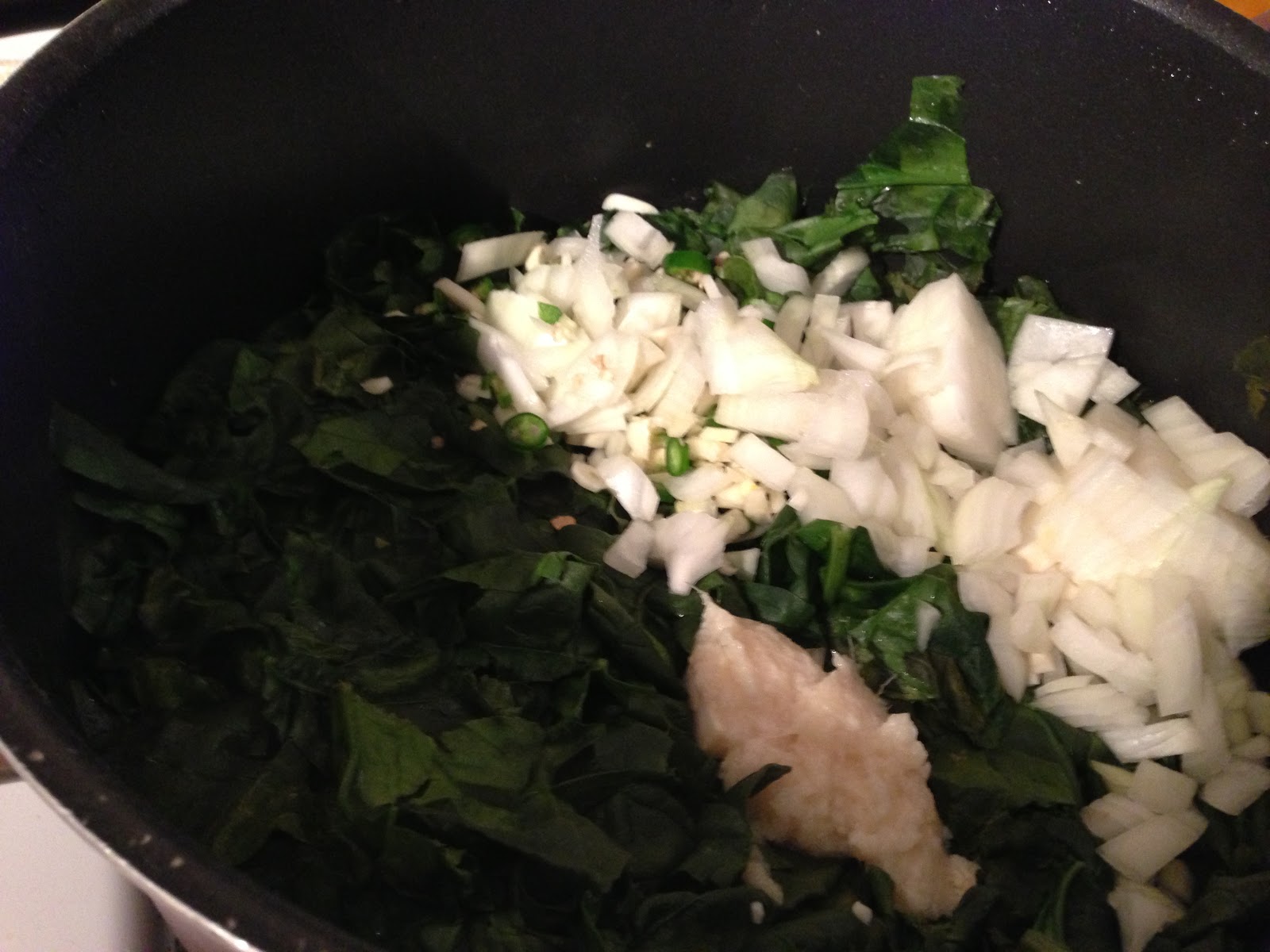
First chop up 2 pounds (about 2 bunches) of mustard greens and 1/2 pound (about a small bag) of spinach and wash the leaves.  Then put them in a large pot.


Next, finely dice one onion, one inch piece of ginger, HALF a garlic bulb (not clove, half a BULB - lots of garlic in this one), and 3 green chilis (you can always add more if you're some kind of super bivi...).


Add it to your pot and cook for 2 1/2 HOURS covered on the LOWEST heat possible.


After you've finished watching your Pakistani soap operas (like all achi gori bivis do...), put all the ingredients from the pot into a blender and blend it until smooth.


Pour it back into your pot and add 1 1/2 Tablespoons of corn meal, NOT CORN STARCH!  I know you want to do corn starch, but don't do it!!!!  It's different.  Add about a tablespoon of salt and cook for about 5 minutes.


And finally, make your BAGHAR!   (And as you make your baghar, you must yell "Baghar! Baghar!")  I don't fully understand what Baghar means yet, but I love how it sounds.

To make your baghar, finely chop up another onion, another inch of ginger, and another half a bulb of garlic and fry in about a 1/2 cup of vegetable/canola oil.  Once everything is softened, pour it all on top of your saag in the pot.


Serve with naan or paratha (but really naan because paratha has a lot of oil in it already).  Mama says you can add some butter, but I didn't want a heart attack so I left it out.  <3


Saturday, November 24, 2012

Bhindi (Okra)


Another simple recipe for an achi gori bivi, is Bhindi (Okra).  Nothing that I would have ever made for myself under the typical American diet.  In fact, I am pretty sure that I had never even eaten it prior to meeting my husband, let alone even heard of it living in Chicago!  This slimy green vegetable is AMAZINGLY DELICIOUS. Once my mother-in-law made it for me, I was hooked.


Start by cutting the caps and tails off of a pound of fresh okra.  You can use frozen okra, but I find it is too mushy.  Fresh okra maintains the firmness of dish without it feeling like you are eating slime.


Your okra should look something like this.


Then chop up a small onion (or half onion if you're using large mega food grocery store onions) and add about a quarter to a half cup of oil in your pot.  Cook the onions until they are soft.

You don't have to add a tomato, but I like to add a chopped tomato.  Add half a teaspoon of tumeric powder and a teaspoon of red chilli powder.  Add almost a tablespoon of salt.  Cover and cook on low heat for about 20 minutes.


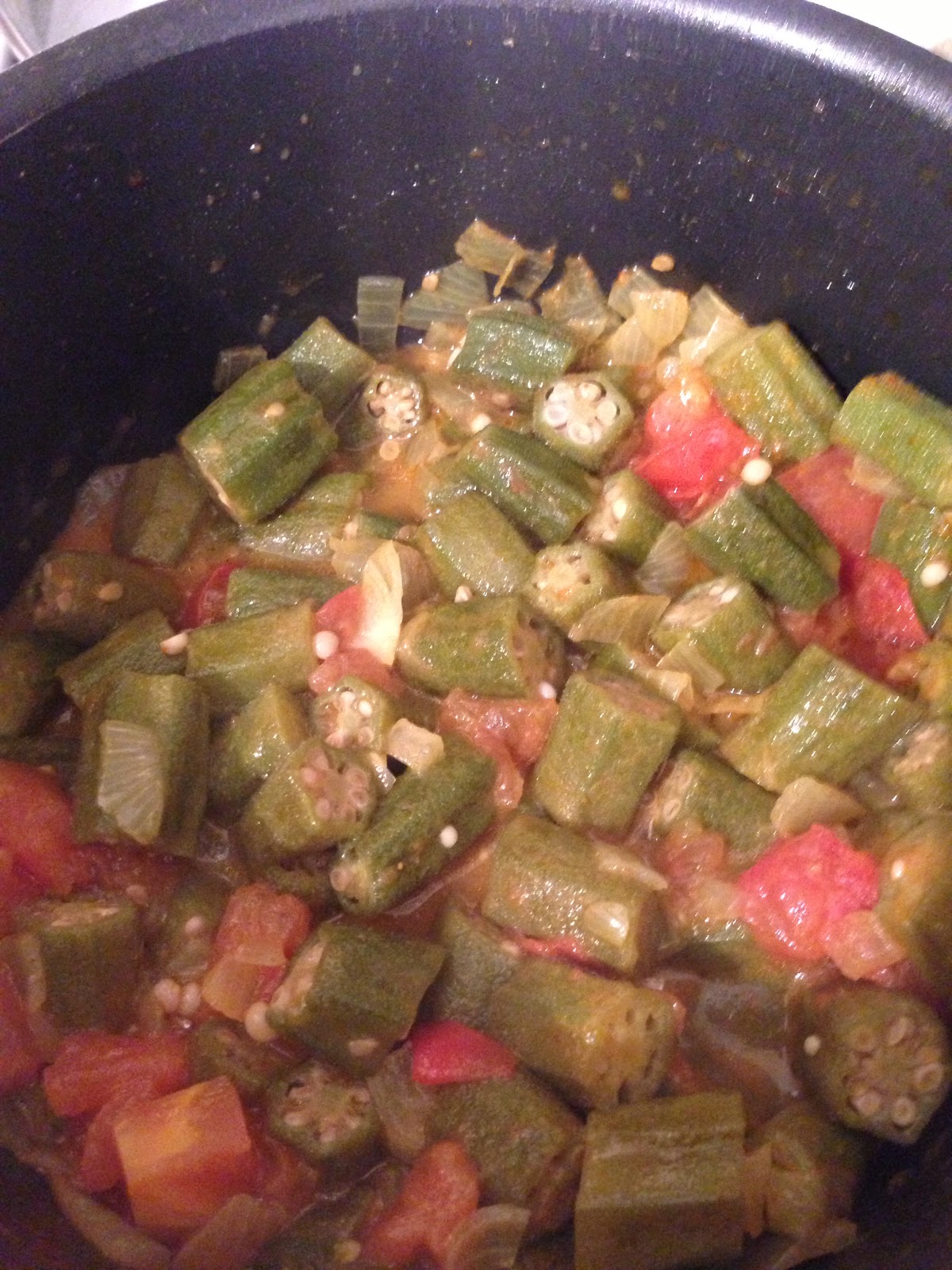
You'll notice that after 20 minutes it will become liquidy, and you'll be like, "let's boil out all that water!"  You can (and should until it looks like the above picture), but notice that when you turn off the heat, it will thicken.


By the end, it should look like the picture below when stirred.


 And that's it!!!  Can you believe it?  Easiest dish ever.  You COULD serve this as a side dish at a davat ("invitation" -- when you have guests over) or just eat it yourself for lunch.


*Note:  Be careful not to stir the okra too much or it will become slimy and mushy.  Try to use a spoon gently while stirring.

Enjoy with naan or paratha.


Saturday, November 17, 2012

Gobhi Aloo (Cauliflower & Potato) Recipe


Gobhi Aloo (Cauliflower & Potato) is a very popular and easy to make homemade dish that every achi bivi should have up her sleeve.  It's a great side dish for davats ("invitations" -- when you are having guests over).  Most American cauliflower dishes tend to be pretty bland, but as with most Pakistani food, gobhi aloo is not bland in the LEAST.


First you finely cut your small onion (we're talking local grocery store small, not food chain mega sizes).  Put it in a medium sized pot and add about a half cup of vegetable/canola oil.  Cook the onions in the oil on medium/high heat until they are soft.  Add about a tablepoon of cumin seeds and cook for a minute or so.

I always do my prep work first.  This saves me time so I don't have to look at the recipe and realize in a panic that I've forgotten to peel the potatoes or chop up some tomatoes or onions...  Above is about 2-3 white potatoes (chopped in ~1-inch pieces), a head of cauliflower (broken into flowerettes and sliced), and 2-3 chopped roma tomatoes.  If you are fast and want to do it while your onions are cooking, go for it!

Add the cauliflower, tomatoes, potatoes, about a tablespoon of red chili pepper flakes, and about a tablespoon of salt.  Add a half cup of water and bring to a boil.  Cover and reduce the heat to low and cook for at least 30 minutes until the potatoes are soft.


Chop up about an inch of ginger and thinly slice 2 green chillis and add to the top of the dish for garnish.  You should also add about 2 tablespoons of fresh cilantro leaves -- I didn't have any fresh, so I didn't add it this time!

 And you are finished!!!

 It is a bit spicy and delicious.  If you're new to the achi gori bivi life, don't put so many green chillis.  Eat with naan or paratha.  Enjoy! :)