Thursday, April 25, 2013

Chukunder Ghosht (Beetroots w/Goat Meat)


Chukunder Ghosht is quite possibly my favorite goat dish.  Pakistanis eat a lot of goat meat.  As an American, I thought it was unusual at first, but now I feel it is better tasting that beef and is generally very, very tender.  When purchasing goat from your local Arab or Pakistani market, you should try to get it from the leg.  Shoulder meat is the other option and it may have more bones (which is not a huge deal, so if your only option is shoulder meat, that's fine).  Just order it how you would order any other meat, "1 pound goat meat, from the leg, cut into pieces."  It's probably quite obvious to Pakistanis how to order this kind of meat, but prior to marrying a Pakistani, I only purchased meat that was pre-packaged on a shelf!  The nice thing about ordering it this way is that the butcher will generally cut the meat into pieces for you, which helps a LOT!

This recipe is wonderful for stomach pains or sensitive stomachs.  It is relatively mild and incredibly tender.  It was one of the few recipes I could enjoy while pregnant and something I have made for my husband recovering from surgery.  It makes a great davvaat (invitation) and at-home meal.  Recently, I made this for my visiting in-laws and was told it tasted exactly like my mother-in-law's!  Enjoy. :)


First, cut off the tails and use a peeler to peel four medium sized beetroots.


Thinly slice your beetroots (if you are good at parring instead of chopping, you might be able to make them even thinner than I did!).


Stack them up and chop them in half.


Finely chop 1 medium onion and fry in 1/2 cup vegetable oil on high heat until golden brown in a large pot.  Add pre-washed 1 pound of chopped goat meat.  Fry until meat changes color.  Add 2 teaspoons ginger & garlic paste, 1 teaspoon red chili powder, ~1 Tablespoon salt, and fry for a few minutes.


Finely chop 1 medium tomato and add it to the pot.  Add beetroot and ~5 cups of water.


Bring to a boil.  Reduce to a simmer (low heat) and cook for 1 1/2 hours, covered.


When you're done, it might look like this (above).  Make sure that you evaporate a good amount of the water until it looks like a gravy (just turn the heat on high and stir continuously until some of the water evaporates -- this can take about 10 minutes).


When it's ready, it will look like this -- notice how the water went down almost 2 inches!  You'll end up having about 1 1/2 cups of water/gravy left over.


Add 3 green chilis and 1/2 teaspoon garam masala.


 Remove from heat into serving bowl.  Top with ~1/2 cup of cilantro leaves and serve with basmati rice or naan.

Tuesday, March 26, 2013

Baigan ka Raita (Eggplant made in Yogurt)


Baigan ka Raita (Eggplant made in Yogurt) is a dish I recently learned from my mother-in-law.  She is visiting now and so I have several recipes that need to be posted.  Unfortunately, there are more photos of recipes than I have time to write up.  However, because this was so great, I am skipping some others that were planned and going straight to this.  It's really a perfect recipe for achi bivis, new and old.  In fact, I've already made it twice in 7 days...  It has a bit of a baba ghanoush taste to it because of the eggplant -- the main differences being that this is made with yogurt and Indian/Pakistani spices, instead of straight eggplant and tahini.  It is great as a side dish, but some people can enjoy it as a main dish.  It is also completely meatless!  A new family favorite here.


Begin with a large eggplant, cut into tiny cubes.


Put everything in a large pot.


Chop up 6 cloves of garlic and throw it in your pot.


Fill pot with enough water to cover the eggplant (it really does not take very much, just until the eggplant floats).


Bring to a boil and cook for 30 minutes on medium-high heat, uncovered.


Stir your eggplant and cook until most/all of the water has evaporated (pictured above).


Remove from pot and mash with a fork.


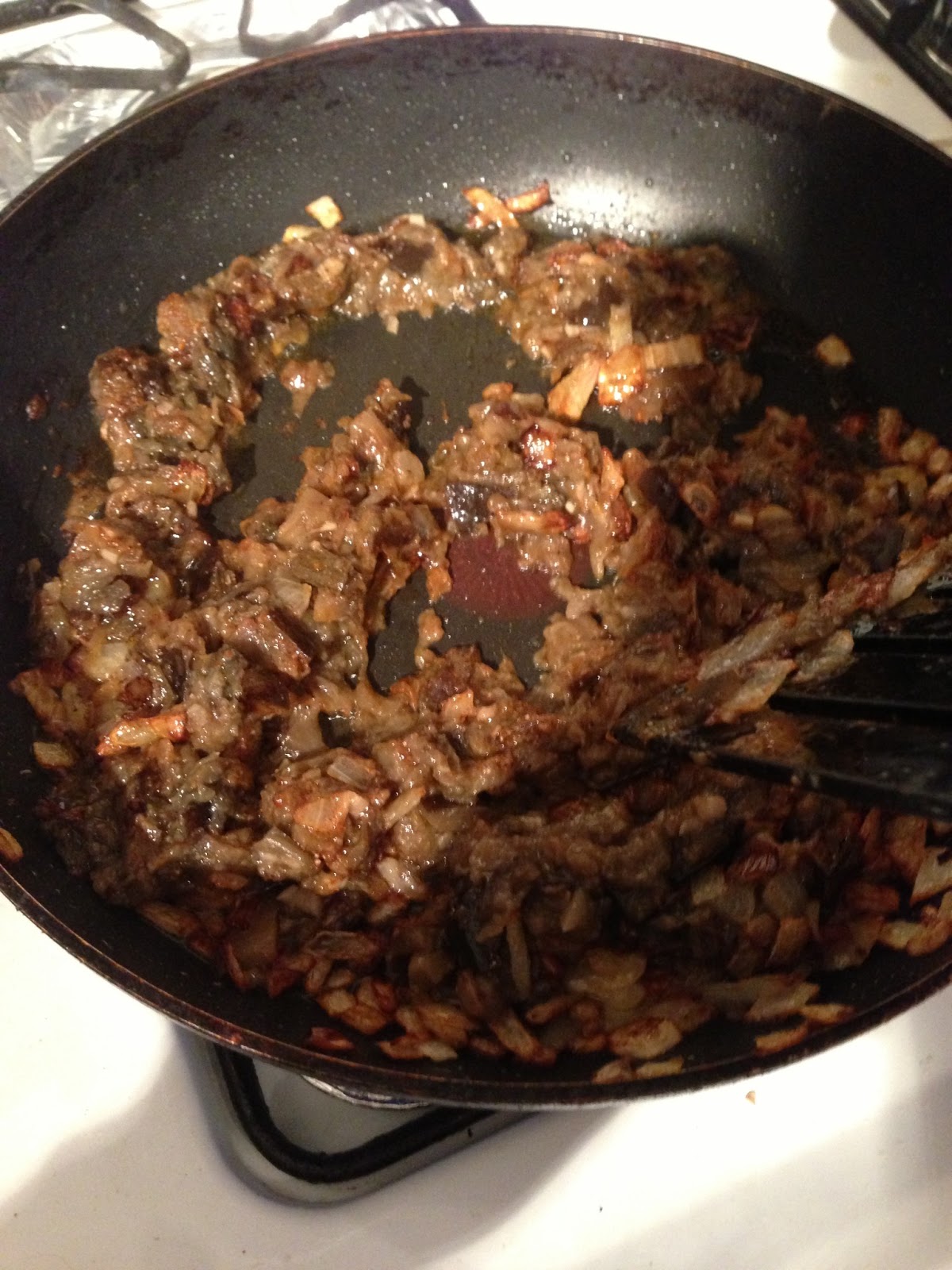
Finely chop 1 small onion (or half a medium sized onion) and put in a large pan with 3 Tablespoons of vegetable oil.


Cook on high heat until onions are golden brown.


When onions are golden, add 1/2 teaspoon red chili powder, 1/2 teaspoon cumin seed powder, 1/2 teaspoon black pepper powder, 1 & 1/4 teaspoon of salt, and eggplant from your bowl.


Fry for 5 minutes.


Remove from heat and let cool.  At this point, you can measure how much you have or if you have good estimation skills, you can eyeball this part.


Look at your eggplant.  Take that amount, plus half of that amount in yogurt and put in a separate bowl (pictured above).  Add 1/2 teaspoon cumin seed powder and 1/2 teaspoon black pepper powder.  Mix well together.


Next, pour your eggplant mixture into the yogurt mixture and slowly combine it together by hand.


Lastly, for my favorite part, the baghar!  If you don't remember how to do a baghar, check it out under the Masoor ki Daal recipe.  Basically, just take a small pan, 1 Tablespoon vegetable oil, 4 round whole red chilis, and 1/2 teaspoon cumin seed, and cook on high heat until brown.  Then quickly pour it on top of your dish, yelling "Baghar!!  Baghar!!!"  Stir.


Garnish with 1/4 cup of cilantro leaves and 1-2 chopped green chilis.  Serve cold  or at room temperature with naan.

Enjoy! :)


Monday, March 11, 2013

Khichri (Rice & Lentils)


Khichri (Rice & Lentils) is a very mild rice and lentil dish.  It contains almost no spices and is highly palatable for someone who has no spice tolerance (common in the U.S.).  Generally, it is served for anyone having digestive pains or needing to eat something bland for whatever reason.  However, my husband and I enjoy it as a regular meal and serve it with various relishes.  It's extremely easy to make and is maybe the equivalent of "macaroni and cheese" when compared to U.S. comfort foods.  You wouldn't really serve it for guests, but you would make it for your family occasionally.

When I first married into a Pakistani family, I remember I had zero spice tolerance.  It was rather difficult for me to eat my mother-in-law's food and I felt terrible because I had been raised to finish all the food on my plate, in typical American fashion.  Somehow I got through it and have since learned to love spicy food, especially hers :).  She was kind enough to make me Khichri, but for some odd reason I thought it had chicken in it and I was so sick from eating so much spicy food that I had negative associations with Khichri for about 5 years... Until I made it for my husband when he was recovering from surgery, I finally gave it another chance.  Surprise, surprise, it's not made with chicken, and it is in fact, delicious.  *Sigh*...  Oh, how I wish I could go back in time with the knowledge I have now.  :)


To make Khichri, rinse several times and then soak 1 cup of basmati rice with 1 cup of red lentils for 15 minutes in a bowl.


Slice 1 small onion (or half a large onion) and put it in a medium saucepan with 1/2 cup of vegetable oil and 1/2 teaspoon of cumin seeds.


Cook on high heat until onions are golden brown.


Drain the rice and lentils and add them to your pot.  Stir fry for a minute.


Add ~1/2 Tablespoon of salt and 2 cups of water.


Cover and keep on low heat for approximately 20-25 minutes (until rice and lentils are soft).


Butter & Achar
Sirkay ki Piyaz
Serve with garlic achar (Indian pickled preserves), sliver of butter per serving, and sirkay ki piyaz (pearl onions in vinegar).  You can buy achar at Indian/Pakistani grocery stores.  And I'll make another post sometime on how to make sirkay ki piyaz.  :)


Enjoy! :)

Saturday, February 9, 2013

Chicken Hara Masala

I know what you are thinking...  "At last!  A meat dish!"  What kind of achi bivi (good wife) doesn't make meat dishes!?!?!  Particularly, one married to a Muslim, Pakistani!?  There are several reasons and I will go into just a few...  
  • Meat is killing animals.  When we make or eat meat, we remember it was a living, breathing animal first.  We eat it knowing and respecting that we did not kill it ourselves and that it was killed on our behalf.
  • Regular meat consumption has been linked to increase obesity, diabetes, and cancer.  The way Americans eat meat is evidenced clearly by our largely obese, high long-term health-risk population.
  • Meat is expensive. Particularly, halal (suitable for Muslims), grass-fed, humanely treated meat.  A whole chicken can run you $10.  Which isn't terrible, but if you ate it everyday, that could be $70 a week on meat!!  That is more than what I usually spend on groceries for an entire week of breakfast, lunch, and dinner for myself and my husband!
You may disagree and that is totally fine!!  Enjoy life as you see fit.  I love you all the same.  These are our personal beliefs and why meat dishes may be found here few and far between.  But I do know how to make them and I do believe it is important to my family that I cook them on occasion.  :)

//end soapbox


Chicken Hara Masala (Green Chicken in sauce) is an excellent chicken dish to prepare for davaats (invitations with guests).  Most Pakistani chicken dishes require you to buy "1 whole chicken, cut in 16 pieces, skinless."  This is about 3lbs of chicken.  If you purchase it at a Pakistani or Muslim marketplace, that is what you would ask for.  I'll have to write another post on how you prepare the chicken, but basically, you wash it in a colander and remove the fat with your fingernails between the meat (this really makes you appreciate that you are eating an animal, by the way).  The fat is all white.  You also remove any excess skin (on the leg pieces and wing pieces for example) and you can also cut the larger breast pieces in half.  Leave the bones in, it will make for a richer sauce.  As you do so, throw the pieces into a large pot.


Incoming a lot of ingredients...Add 3 Tablespoons of oil, 1/4 cup of Puck cream (found in most Pakistani/Indian/Arab grocery stores -- do not try to substitute this, I've never seen it in American grocery stores), 4 teaspoons ginger and garlic paste, 2 teaspoons garam masala powder, 4 Tablespoons lemon juice, ~1 Tablespoon salt, 1 teaspoon red chili powder, 1/2 teaspoon tumeric powder, 6 whole red chilies, 1 teaspoon ground cumin powder, 4 chopped, fresh green onions.


This is what it will look like mixed.  Cook on medium/high heat until most of the liquid has evaporated and chicken is cooked (~35 minutes), stirring occasionally.


Meanwhile, boil about 2 large handfuls of chopped spinach (boiled, it should make about a half cup) in a small saucepan. 


This is what it will look like when it is ready for the next step.


While you are waiting, make a small bowl of 3-4 chopped green chilies, 2 teaspoons qasuri methi (fenugreek leaves -- you can get them at Indian/Pakistani/Arab grocery stores), and 1/2 cup of chopped cilantro leaves.


You'll also need 3/4 cup whole milk yogurt (I use the above yogurt and qasuri methi leaves).


 Add your small bowl of ingredients, yogurt, and drained, boiled spinach to your chicken.


This is what it will look like stirred.


Cook on high until chicken mix is thick (about 5 minutes).  You can serve it now, or you can leave it on the lowest heat setting, covered for an hour or more to make it extra tender (checking occasionally to make sure it doesn't burn or anything).

Enjoy with naan or rice!  :)